4 Injectable Medicine Forms Every Pharma Professional Should Know
An injection may look simple from the outside: a vial, a syringe, or an infusion bag. But behind that finished product is a carefully selected injectable formulation designed around stability, sterility, storage, packaging, and administration requirements.
Some medicines are supplied as ready-to-use liquids. Others arrive as powders that need reconstitution. Some are designed for controlled intravenous infusion, while others undergo lyophilization, or freeze-drying, to improve the suitability of the finished formulation.
For pharmaceutical companies, distributors, hospitals, and healthcare businesses, understanding these differences can make it easier to evaluate an injectable product portfolio and manufacturing partner.
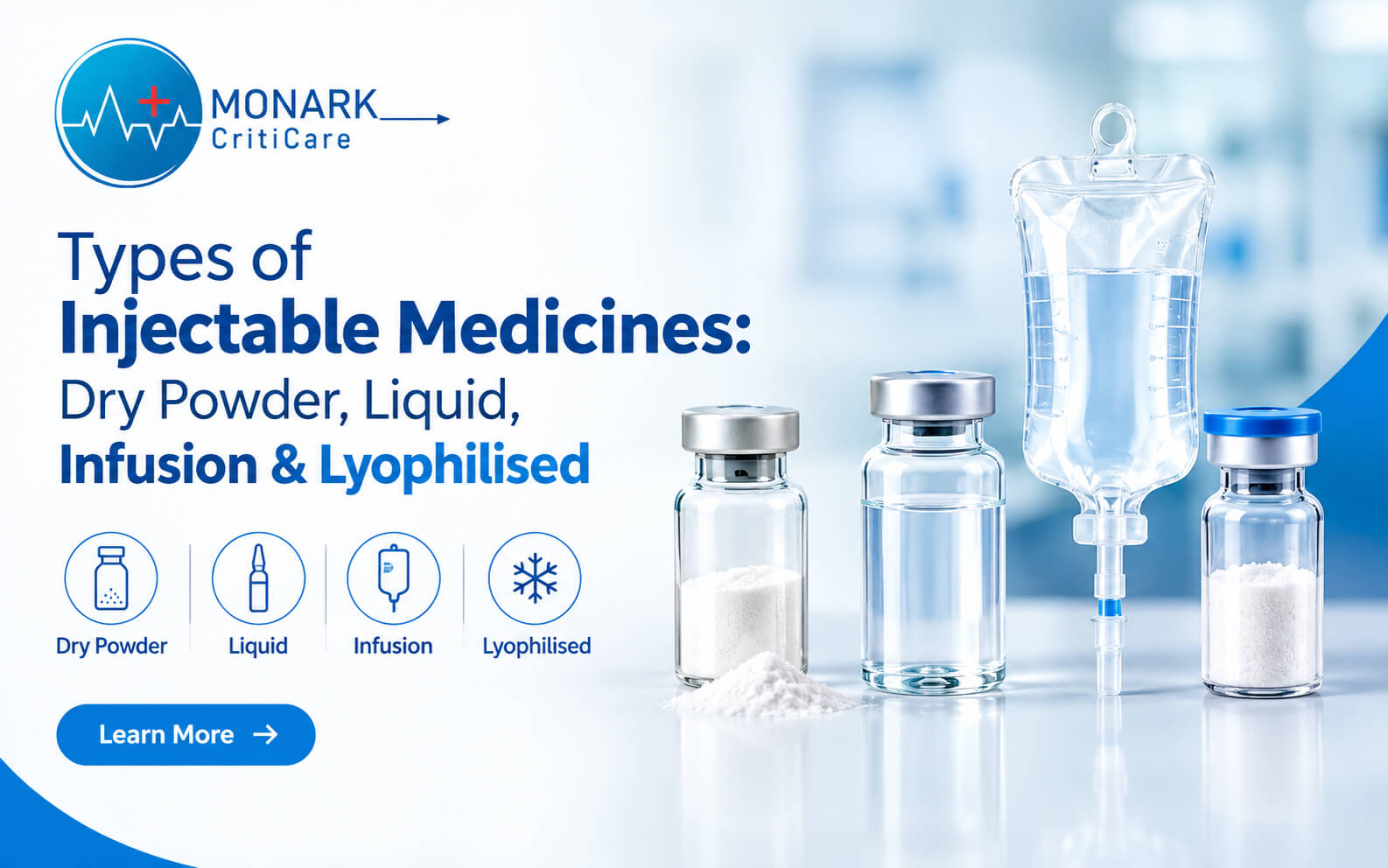
In this article, we’ll look at the four important categories of injectable medicines: dry powder, liquid, infusion, and lyophilised injections, and explain what makes each formulation different.
What Are the Main Types of Injectable Medicines?
The major types covered here are:
- Dry powder injections – supplied in powder form and may require reconstitution.
- Liquid injectable medicines – supplied as liquid preparations.
- IV infusion medicines – designed for controlled intravenous administration.
- Lyophilised injections – freeze-dried pharmaceutical preparations that commonly require reconstitution.
The appropriate formulation depends on factors such as the active ingredient, stability, solubility, moisture sensitivity, packaging requirements, and manufacturing process.
What Are Injectable Medicines?
Injectable medicines are pharmaceutical preparations intended for administration through an injection or infusion route rather than through the digestive system. They are commonly included within the broader category of parenteral dosage forms.
Unlike tablets or capsules, injectable products require specialised formulation and manufacturing considerations. Sterility, contamination control, container closure, storage, and product-specific quality requirements are particularly important.
Depending on the formulation, an injectable medicine may be supplied as:
- A sterile liquid
- A dry powder
- A freeze-dried preparation
- An infusion solution
- Another specialised sterile preparation
This is why the term “injection” does not describe just one type of pharmaceutical product.
4 Major Types of Injectable Medicines
1. Dry Powder Injections
Imagine opening a vial and finding no liquid inside, only a carefully prepared sterile powder. That is the basic idea behind a dry powder injection.
These products are supplied in dry form and, where required, are reconstituted with an appropriate diluent before administration according to the product's approved instructions.
Why are medicines supplied as dry powder?
For some formulations, maintaining the active ingredient in a dry state can be an appropriate approach to formulation stability. The final dosage form depends on the characteristics of the active pharmaceutical ingredient and the formulation design.
A powder for injection may be filled into a sterile vial and sealed under controlled manufacturing conditions.
Key characteristics of dry powder injections
- Dry sterile pharmaceutical preparation
- Commonly supplied in vials
- May require reconstitution
- Requires appropriate storage conditions
- Manufactured under controlled conditions
- Requires suitable sterile packaging
Dry powder does not always mean lyophilised
This is an important distinction.
The phrase dry powder injection describes the physical form of the product. Lyophilized injection, on the other hand, refers to a product produced through a specific freeze-drying process.
Therefore, while both may appear as dry products, they should not automatically be treated as identical formulations.
2. Liquid Injectable Medicines
Liquid preparations are probably the form most people associate with injections.
Liquid injectable medicines are supplied in liquid form and may be formulated as sterile solutions or other suitable liquid preparations.
Depending on the product, these may be supplied in vials, ampoules, pre-filled syringes, or other appropriate packaging formats.
What makes liquid injectables different?
The active ingredient must remain suitably stable within the liquid formulation throughout the relevant storage period.
This makes formulation development important. Solubility, compatibility, pH, excipients, packaging, and storage conditions can all be relevant considerations.
Key characteristics of liquid injectable medicines
- Supplied in liquid form
- May be presented as a sterile solution
- Can be packaged in vials or ampoules
- Generally does not require powder reconstitution in the same manner
- Requires appropriate sterile manufacturing controls
- Needs suitable storage and handling conditions
For pharmaceutical companies building an injectable portfolio, liquid presentations can complement dry powder and lyophilised products.
3. IV Infusion Medicines
Not every injectable medicine is administered in the same way.
IV infusion medicines are designed for controlled intravenous administration, generally delivering the preparation over a period of time rather than as a rapid injection.
Infusion products can be particularly important in hospital and critical-care settings, where healthcare providers may require a broad range of sterile pharmaceutical preparations.
What are infusion medicines?
An infusion medicine is generally supplied as a sterile liquid preparation intended for controlled administration. Depending on the individual product, the presentation may involve a larger volume than a conventional injection.
Commonly associated terminology includes:
- IV infusion
- Intravenous infusion
- Infusion solution
- Parenteral infusion
- Large volume parenteral (LVP)
Key characteristics
- Usually supplied as a sterile liquid preparation
- Designed for controlled administration
- Commonly associated with intravenous use
- May be available in larger-volume presentations
- Requires suitable sterile packaging
- Requires stringent manufacturing and quality controls
Injection vs infusion: are they the same?
Not exactly.
An injection generally describes administration through an injection route, while an infusion involves delivering a preparation gradually over a period of time.
The actual route, dose, rate, and administration instructions always depend on the individual medicine and its approved product information.
4. Lyophilised Injections
Now we come to one of the most specialised formulations in this list.
Lyophilised injections, also written as lyophilized injections, are products prepared using lyophilization, commonly called freeze-drying.
Instead of keeping the formulation in a liquid state, the product undergoes a controlled drying process designed to remove water from the prepared formulation.
The finished product may appear as a dry cake or porous solid inside a vial and may require reconstitution before administration.
Why are some injections lyophilised?
Certain active ingredients can present stability challenges when maintained in liquid form.
In appropriate formulations, lyophilization can provide a way of producing a dried pharmaceutical presentation with characteristics suited to the product's stability requirements.
The process involves carefully controlled stages, and the exact cycle depends on the formulation and manufacturing process.
Key characteristics of lyophilised injections
- Produced using freeze-drying
- Usually supplied as a dry cake or porous solid
- Commonly requires reconstitution
- Requires specialised manufacturing equipment
- Requires controlled processing conditions
- Needs appropriate packaging and storage
Lyophilised vs dry powder injections
These terms are often confused.
A dry powder injection is a general description based on the physical form.
A lyophilised injection specifically refers to a product that has undergone the lyophilization process.
That distinction is important when discussing injectable manufacturing because the manufacturing process, equipment, formulation development, and processing parameters can be different.

Dry Powder vs Liquid vs Infusion vs Lyophilised Injections
A quick comparison makes the differences easier to understand.
|
Type of Injectable |
Physical Form |
Reconstitution |
Main Feature |
|
Dry Powder Injection |
Dry powder |
May be required |
Powder presentation |
|
Liquid Injectable Medicine |
Liquid |
Generally not required in the same way |
Ready liquid formulation |
|
IV Infusion Medicine |
Liquid |
Product-dependent |
Controlled intravenous administration |
|
Lyophilised Injection |
Freeze-dried preparation |
Commonly required |
Produced through lyophilization |
The important point is that no single formulation is universally appropriate for every medicine. The selected dosage form depends on the product's characteristics and pharmaceutical requirements.
What Determines an Injectable Formulation?
Choosing an injectable dosage form involves much more than deciding whether a product should be a powder or liquid.
Several factors can influence formulation and manufacturing decisions.
1. Stability
The active pharmaceutical ingredient needs to remain within the required quality specifications throughout its approved shelf life.
2. Solubility
The solubility characteristics of an active ingredient can influence whether a liquid formulation is practical or whether another dosage form should be considered.
3. Moisture Sensitivity
Some pharmaceutical ingredients are sensitive to moisture. For appropriate products, a dried formulation may be considered during development.
4. Packaging
The formulation must be compatible with its container. Vials, ampoules, syringes, and infusion containers may be used depending on the product.
5. Reconstitution
Some dry formulations require reconstitution before administration. The exact diluent, volume, procedure, and storage conditions must always follow the approved product information.
6. Manufacturing Process
The selected dosage form affects the manufacturing process, equipment, environmental controls, filling process, packaging, and quality-control requirements.
How Are Injectable Medicines Manufactured?
The production of sterile injectable products requires specialised manufacturing controls.
Although the exact process differs between liquid, dry powder, infusion, and lyophilised products, manufacturing may involve stages such as:
- Raw material selection and testing
- Formulation preparation
- Filtration where applicable
- Sterile filling
- Vial or ampoule filling
- Aseptic processing
- Lyophilization where required
- Container closure
- Quality-control testing
- Batch documentation and release
This is where choosing the right manufacturing partner becomes important.
A company looking for GMP-certified injectable manufacturing should consider not only production capacity but also quality systems, documentation, testing capabilities, product range, packaging capabilities, and regulatory requirements.
Why Choose a Specialised Critical Care Injectable Manufacturer?
For hospitals, distributors and pharmaceutical businesses, injectable manufacturing requires a different level of attention than many conventional dosage forms.
A specialised critical care injectable manufacturer can provide expertise across multiple injectable presentations while maintaining processes designed around sterile pharmaceutical production.
Monark Criticare focuses on critical care injectables and offers multiple injectable formats, including dry powder injections, IV infusion medicines, liquid injectable medicines, and lyophilised injections.
This broad dosage-form approach can be useful for businesses looking to develop or expand an injectable product portfolio.
Explore the Injectable Product Range
If you are looking for injectable products across different therapeutic categories, you can explore the Monark Criticare product range to see the company's current portfolio.
Third-Party Injectable Manufacturing: An Opportunity for Pharma Businesses
Not every pharmaceutical company wants to establish and operate its own injectable manufacturing facility.
This is where third-party injectable manufacturing can become relevant.
Under a third-party manufacturing arrangement, a pharmaceutical business can work with a manufacturing partner for selected products while focusing its own resources on areas such as marketing, distribution, sales, and business development.
Before entering such an arrangement, businesses should evaluate:
- Manufacturing capabilities
- Product portfolio
- Quality systems
- Documentation
- Packaging options
- Batch testing
- Regulatory support
- Production capacity
- Supply reliability
Monark Criticare offers Third-Party Manufacturing services for pharmaceutical businesses looking to develop and market injectable products.
More Ways to Partner with Monark Criticare
Injectable manufacturing is only one potential business route.
Depending on the company's requirements, pharmaceutical businesses can also explore:
PCD Pharma Franchise
The PCD pharma franchise model offers pharmaceutical entrepreneurs and distributors an opportunity to build a product portfolio within their applicable market and licensing framework.
Ethical & Prescription Division
The Ethical & Prescription Division focuses on prescription-oriented pharmaceutical products and professional healthcare markets.
Global Pharma Export
For businesses targeting international markets, Global Pharma Export can be explored based on the destination country's regulatory requirements.
Partner With Us
Businesses interested in manufacturing, distribution, franchise, or other pharmaceutical opportunities can explore the Partner with Us option.
Why the Right Injectable Format Matters
The physical appearance of an injectable medicine tells only part of its story.
Behind every vial, ampoule, or infusion container is a formulation designed around specific pharmaceutical requirements.
- Dry powder injections may require reconstitution.
- Liquid injectable medicines are supplied in a liquid presentation.
- IV infusion medicines are designed for controlled infusion.
- Lyophilised injections use freeze-drying to create a dried formulation.
Understanding these differences gives pharmaceutical businesses a clearer picture when comparing product portfolios and manufacturing capabilities.
Conclusion
The world of injectable medicines includes far more than conventional liquid injections.
From dry powder injections and liquid injectable medicines to IV infusion medicines and lyophilised injections, each formulation has its own characteristics, manufacturing considerations, and handling requirements.
For pharmaceutical companies, choosing the right product and manufacturing partner means looking beyond the label. Product range, quality systems, manufacturing capabilities, documentation, packaging, and supply support all deserve attention.
Monark Criticare is focused on critical care injectables and provides multiple injectable dosage formats along with pharmaceutical partnership opportunities.
Businesses interested in GMP-certified injectable manufacturing, third-party injectable manufacturing, PCD pharma franchise, ethical pharmaceutical products, or export opportunities can connect with Monark Criticare to discuss their requirements.
Monark Criticare
Plot No. 201, Ground Floor, HSIIDC Phase 1, Industrial Area, Alipur, Barwala, Panchkula, Haryana 134118, India
Email: monarkcriticare@gmail.com
Phone: +91 90567 60548 | +91 98886 56719 | +91 93176 92852
WhatsApp: +91 90567 60548
Disclaimer:
This article is provided for general pharmaceutical and educational information only. It is not medical or prescribing advice. Injectable medicines should be used only according to approved product information and the direction of qualified healthcare professionals. Product availability, composition, indications, storage requirements, and regulatory status may vary by product and market.
Frequently Asked Questions
01. What are the four main types of injectable medicines?
Four important categories are dry powder injections, liquid injectable medicines, IV infusion medicines, and lyophilised injections. Injectable medicines can also be classified according to route of administration and other dosage-form characteristics.
02. What is a dry powder injection?
A dry powder injection is supplied as a sterile powder and may require reconstitution with an appropriate diluent before administration, depending on the individual product.
03. What is a liquid injectable medicine?
A liquid injectable medicine is supplied in liquid form and may be presented as a sterile solution or another suitable injectable preparation.
04. What are IV infusion medicines?
IV infusion medicines are sterile preparations intended for controlled intravenous administration. Their volume, packaging, rate, and administration requirements depend on the specific product.
05. What does lyophilised mean in pharmaceuticals?
Lyophilised means that a pharmaceutical formulation has undergone lyophilization, or freeze-drying, to produce a dried preparation.
06. Are dry powder and lyophilised injections the same?
No. Dry powder is a broader description of a powder-based product, while a lyophilised injection specifically refers to a product produced through a freeze-drying process.
07. Why are some injectable medicines freeze-dried?
For suitable formulations, freeze-drying can be used to create a dried product when the formulation's stability characteristics make this approach appropriate.
08. What should I look for in an injectable manufacturer?
Consider the manufacturer's dosage-form capabilities, quality systems, documentation, manufacturing infrastructure, product portfolio, testing capabilities, regulatory support, and supply capacity.