

Critical Care Medicine Procurement: A Hospital Buyer's Field Guide to Choosing the Right Supplier
A practical guide to product quality, supplier verification, pricing, and supply continuity
Selecting a supplier for critical care medicines is not just about finding the lowest price. Hospitals must also consider product quality, regulatory compliance, stock availability, and timely delivery to ensure uninterrupted patient care.
Which one should you choose?
For hospital procurement teams, the answer requires more than comparing prices. Critical care medicine procurement involves assessing supplier credentials, product documentation, manufacturing standards, delivery arrangements, and the ability to meet ongoing hospital requirements.
A structured evaluation process helps buyers ask better questions, identify potential risks, and make decisions based on verifiable information.
This field guide breaks the process into practical checkpoints, helping hospitals, nursing homes, and healthcare purchasing teams assess a critical care pharmaceutical supplier with greater confidence.
7 Questions Every Hospital Buyer Should Ask Before Procuring Critical Care Medicines
Hospital procurement of critical care medicines requires careful evaluation to ensure patient safety, consistent availability, and reliable quality. Buyers must assess product quality, regulatory compliance, supplier credibility, pricing, and timely delivery before placing an order.
Asking the right questions helps hospitals minimize supply chain risks and make informed purchasing decisions. Here are the 7 checkpoints every hospital buyer should consider before procuring critical care medicines.
Checkpoint 1: Start With the Hospital's Actual Requirements
Before contacting suppliers, establish exactly what your hospital needs. An unclear purchase request can lead to mismatched products, unnecessary inventory, and avoidable delays.
Build your requirements around the following details:
- Generic name and required strength.
- Dosage form and pack size.
- Expected order quantity and replenishment frequency.
- Required documentation and product approvals.
- Storage and handling requirements.
- Delivery location and expected timeline.
This information gives suppliers a consistent basis for responding to your enquiry.
It also makes it easier to compare quotations fairly. A price comparison is meaningful only when the products and commercial terms being compared are equivalent.
Buyer's takeaway: Prepare a standard purchase specification before requesting quotations.
Read also: Critical Care Pharma Products for Hospitals
Checkpoint 2: Verify the Supplier Before Comparing Prices
A professional website or attractive product catalogue is a starting point, not proof of a supplier's credentials.
Determine whether you are dealing directly with a manufacturer, an authorised distributor, or another pharmaceutical business. Then verify the licences, authorisations, and documentation relevant to the transaction.
For a critical care injectable manufacturer, ask about the manufacturing site, applicable regulatory approvals, quality systems, and supporting product records. Verify certificates and licences with the issuing authority where appropriate.
Pay particular attention to whether the supplier's stated credentials apply to the actual products and manufacturing operations involved.
What should buyers request?
|
Verification area |
Evidence to review |
|
Legal status |
Business identity and applicable licences |
|
Product authorisation |
Relevant product approvals and registrations |
|
Manufacturing |
Site details and applicable manufacturing permissions |
|
Quality credentials |
Current, verifiable certifications where applicable |
|
Distribution |
Authorisation and sourcing records where required |
Do not assume that every supplier has identical authorisations or that a certification covers every product in its catalogue.
Buyer's takeaway: Verify the business and the relevant products independently before approving a supplier.
Checkpoint 3: Audit the Product Catalogue for Suitability
A large product catalogue can be useful, but the real question is whether it matches your hospital's requirements.
Review the critical care medicine product list and confirm the specific medicines, strengths, formulations, and pack sizes your team needs. Product availability should also be confirmed directly rather than inferred from a catalogue listing.
Depending on its clinical requirements, a hospital may evaluate anti-infective medicines, cephalosporins, intravenous infusion products, and other supportive medicines.
Monark Criticare provides online product-category pages that buyers can review when exploring potential products:
- Browse the critical care product range
- Explore anti-infective products
- Review the cephalosporin category
- View the complete product catalogue
These pages are useful for initial product discovery. Before ordering, confirm the exact specifications, current availability, applicable approvals, and commercial terms with the company.
Don't overlook formulation differences
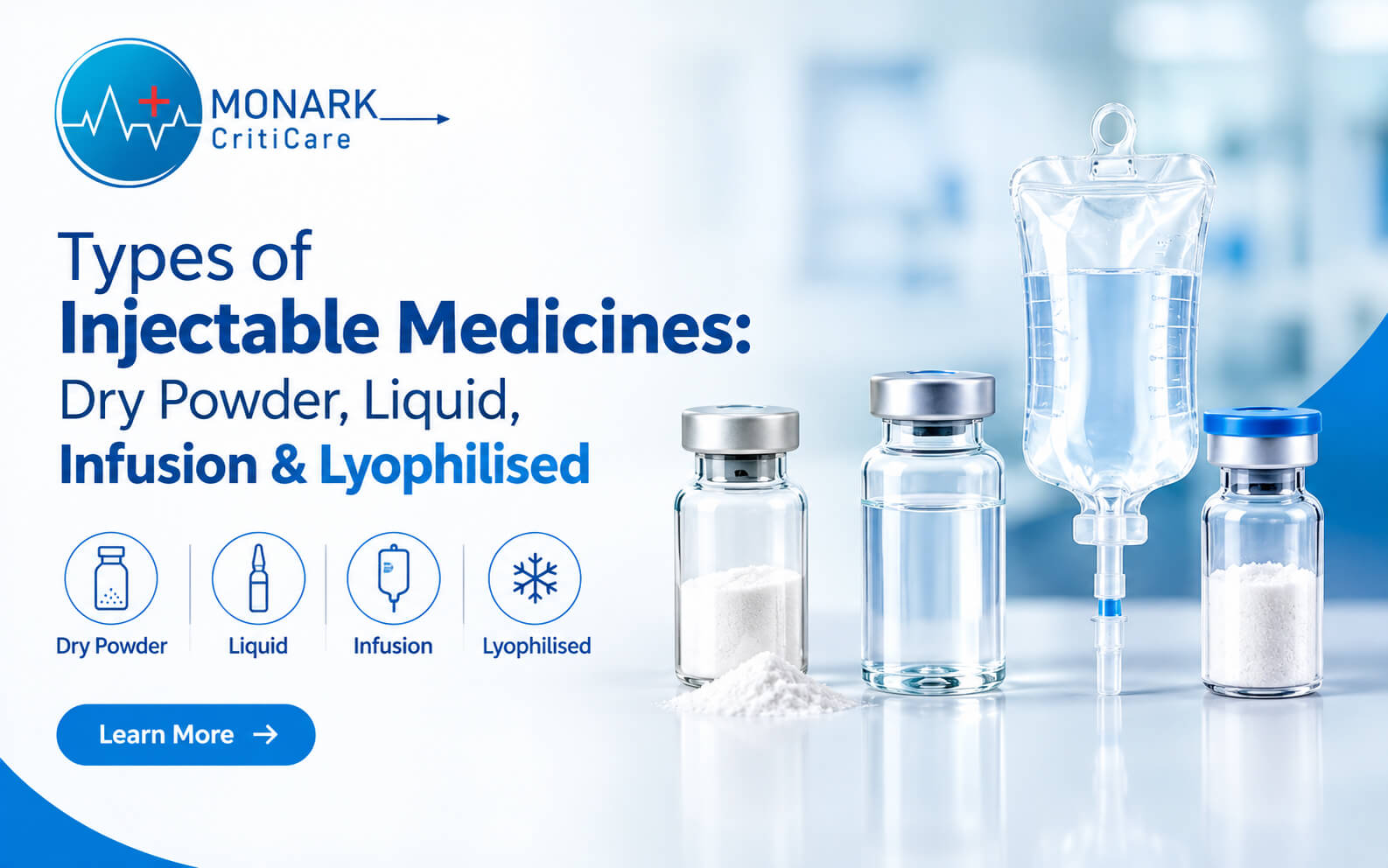
The different types of injectable medicines may have different preparation, administration, packaging, and storage requirements. For example, an infusion product and a powder requiring reconstitution are not interchangeable simply because they contain a related medicine.
Procurement specifications should therefore match the hospital's approved requirements and be reviewed by the appropriate pharmacy or clinical team.
Buyer's takeaway: Evaluate the exact product, not just the supplier's overall range.

Checkpoint 4: Examine Quality and Batch Documentation
Quality assurance is a critical checkpoint when sourcing sterile injectable medicines.
Ask what evidence is available to demonstrate that products meet their applicable specifications. Depending on the product and regulatory requirements, documentation may include certificates of analysis, batch-release records, sterility testing, endotoxin testing, stability information, and approved labelling.
The supplier should also be able to explain how product complaints, defects, recalls, and traceability are handled.
A practical documentation review
Before approving a purchase, establish whether your team can verify:
- Product identity, strength, and dosage form.
- Batch or lot identification and expiry date.
- Applicable product approvals and labelling.
- Relevant quality-control and batch-release documentation.
- Product-specific storage and transport conditions.
- Procedures for reporting defects and managing recalls.
The precise requirements will vary according to the medicine, applicable regulations, and hospital purchasing policies.
Buyer's takeaway: Ask for relevant evidence and review it; do not rely solely on general quality assurances.
Checkpoint 5: Compare the Complete Cost of Procurement
The lowest quotation is not always the most economical option.
A meaningful comparison includes the product price, pack size, applicable taxes, freight, minimum order quantity, payment terms, and any additional charges. Buyers should also account for practical considerations such as delivery performance and the suitability of the proposed order quantity.
Use a consistent comparison sheet:
|
Commercial factor |
Supplier A |
Supplier B |
Supplier C |
|
Comparable product specification |
Verify |
Verify |
Verify |
|
Quoted unit price |
Record |
Record |
Record |
|
Taxes and freight |
Record |
Record |
Record |
|
Minimum order quantity |
Record |
Record |
Record |
|
Delivery commitment |
Confirm |
Confirm |
Confirm |
|
Payment terms |
Record |
Record |
Record |
|
Documentation requirements met |
Check |
Check |
Check |
Complete this table using actual supplier quotations rather than assumptions.
This approach allows procurement teams to distinguish a genuinely competitive offer from one that appears inexpensive but carries additional costs or unsuitable terms.
Buyer's takeaway: Compare equivalent products on total cost and verified service commitments.
Checkpoint 6: Test the Supplier's Delivery and Supply Arrangements
A suitable medicine must also arrive through an appropriate, dependable supply process.
Discuss expected lead times, order processing, dispatch schedules, shipment tracking, and how the supplier communicates delays. Ask whether the proposed arrangement can support the hospital's forecasted demand and replenishment schedule.
For products with specified temperature or handling requirements, confirm the applicable transport conditions and supporting records. Different injectable medicines can have different storage requirements, so buyers should avoid assuming that one procedure applies to every product.
Hospitals should maintain their own inventory controls and contingency plans. A supplier's assurance of future availability should not replace appropriate stock management.
Buyer's takeaway: Confirm delivery expectations and handling requirements before committing to a purchasing arrangement.
Checkpoint 7: Look Beyond the First Order
The purchasing relationship continues after the first delivery.
A supplier evaluation should include responsiveness, document accuracy, order communication, complaint resolution, and the ability to address discrepancies appropriately.
Agree on practical procedures for:
- Reporting missing or incorrect items.
- Obtaining outstanding product documentation.
- Escalating quality concerns.
- Communicating recalls or product safety issues.
- Reviewing supplier performance over time.
Where appropriate, use a periodic supplier scorecard to track delivery performance, documentation completeness, and issue-resolution timelines.
A long-term relationship should be supported by clear responsibilities and evidence of satisfactory performance, rather than promises alone.
Buyer's takeaway: Evaluate how a supplier manages problems, not just how it handles successful orders.
The Hospital Buyer's Supplier Scorecard
Use this scorecard to organise your assessment. Set the weighting for each category according to your hospital's purchasing policy and product-specific risks.
|
Evaluation category |
Suggested weight |
|
Licences and regulatory suitability |
20% |
|
Product quality and documentation |
25% |
|
Product range and specification match |
15% |
|
Price and commercial terms |
15% |
|
Delivery and supply arrangements |
15% |
|
Customer support and issue resolution |
10% |
|
Total |
100% |
Score each supplier against the same evidence requirements. These suggested weights are illustrative, not a regulatory standard. Adjust them to reflect your organisation's policies and the products being purchased.
A supplier that offers an attractive price but cannot satisfy essential licensing, product-quality, or documentation requirements should not be treated as acceptable simply because its overall score is high.
Trending in 2026: The Future of Critical Care Medicine Procurement
The future of critical care medicine procurement is getting smarter, faster, and more data-driven. From AI-powered inventory forecasting to digital supplier discovery, emerging technologies are reshaping how hospitals source essential medicines.
Here are four trends to watch:
- AI-Powered Procurement: Smarter demand forecasting and inventory planning.
- Digital Traceability: Better batch tracking and product verification.
- Supply Chain Resilience: Proactive sourcing strategies to reduce supply disruptions.
- Digital Supplier Discovery: Faster access to product catalogues and supplier information.
For hospitals, staying ahead means combining technology with verified suppliers, reliable documentation, and robust quality checks.
Explore the Monark Criticare Critical Care Product Catalogue to discover relevant product categories.
The future of procurement isn't just lower costs; it's smarter sourcing and dependable supply.
Where Do Manufacturing Partnerships and Exports Fit In?
Hospital purchasing is different from pharmaceutical manufacturing partnerships and international trade.
Third-party pharmaceutical manufacturing may suit businesses seeking contract production, subject to appropriate licences, agreements, and regulatory responsibilities.
A PCD pharma franchise is a separate commercial model involving product marketing and distribution arrangements. Businesses should review the actual offering, territorial rights, contractual terms, and applicable authorisations.
Pharmaceutical export introduces additional considerations, including destination-country registration, import permissions, product labelling, and export documentation.
These are separate search and commercial intents. Buyers interested in these services should confirm directly with Monark Criticare which arrangements it currently offers and which markets it serves.
Quick Reference: Critical Care Medicine Procurement Checklist
Before finalising a supplier, confirm that your team has:
- Defined the exact product and quantity requirements.
- Verified the supplier's applicable credentials.
- Reviewed product approvals and relevant quality records.
- Compared equivalent quotations and total costs.
- Confirmed stock availability and delivery expectations.
- Checked storage, handling, and traceability requirements.
- Established complaint and escalation procedures.
- Documented the supplier approval decision.
This checklist can help standardise purchasing decisions and support a more transparent procurement process.
Final Word: Make Every Procurement Decision Evidence-Based
Reliable critical care medicine procurement begins with clear requirements and ends with a documented, defensible supplier decision.
By verifying credentials, reviewing quality records, comparing complete costs, and assessing supply arrangements, hospital procurement teams can build a more consistent approach to supplier selection.
Monark Criticare's official website and critical care product category provide starting points for exploring relevant product offerings. Contact the company directly to confirm product specifications, current availability, documentation, and commercial terms.
Contact Monark Criticare
- Address: Plot No. 201, Ground Floor, HSIIDC Phase 1, Industrial Area, Alipur, Barwala, Panchkula, Haryana 134118, India
- Email: monarkcriticare@gmail.com
- Phone: +91 90567 60548 | +91 98886 56719 | +91 93176 92852
- WhatsApp: +91 90567 60548
A structured procurement process does more than simplify purchasing. It helps your organisation make decisions based on verified requirements, transparent comparisons, and appropriate quality controls.
Frequently Asked Questions
01. What is critical care medicine procurement?
Critical care medicine procurement is the process of identifying, evaluating, purchasing, and managing medicines required by hospitals and other healthcare facilities for critical care services.
02. How should a hospital choose a critical care pharmaceutical supplier?
Hospitals should verify applicable licences, product approvals, quality documentation, product suitability, pricing, delivery arrangements, traceability, and customer support before approving a supplier.
03. What should buyers check when purchasing injectable medicines?
Check the exact formulation, strength, packaging, applicable approvals, batch documentation, storage requirements, and supplier credentials. Product-specific clinical and pharmacy requirements must also be followed.
04. Why is batch documentation important?
Batch documentation supports traceability, verification of product information, investigation of quality complaints, and appropriate recall procedures.
05. How can hospitals compare pharmaceutical suppliers fairly?
Use standardised specifications and compare equivalent products, total costs, required documentation, delivery commitments, and support arrangements against the same evaluation criteria.
Disclaimer: This article is intended for informational and educational purposes only. It does not constitute medical, pharmaceutical, or regulatory advice. Product availability, specifications, certifications, and regulatory requirements may change and should be verified directly with the relevant manufacturer or authorised supplier. Hospitals should consult qualified healthcare professionals and follow applicable laws and procurement policies before purchasing medicines. References to Monark Criticare are for informational purposes and do not guarantee product suitability or availability.