
When hospitals need essential medicines, every detail matters, from product specifications and quality documentation to stock availability and delivery schedules. Hospital pharmacies, intensive care units, and emergency departments rely on organised pharmaceutical procurement to meet day-to-day needs. For procurement teams, finding a suitable supplier is not simply about purchasing medicines; it is about establishing a supply arrangement that meets institutional needs and applicable regulatory standards.
However, sourcing the right critical care pharmaceutical products can be challenging. Buyers must evaluate different formulations, verify product documentation, manage inventory, and coordinate purchasing across departments. A dependable procurement process can help simplify these tasks and make supplier evaluation more efficient.
This is where an informed approach to hospital pharmaceutical supply becomes valuable. By understanding available product categories and carefully evaluating suppliers, hospitals and healthcare institutions can make better purchasing decisions.
Monark Criticare provides a starting point for exploring critical care pharmaceutical products and related pharmaceutical business opportunities. This article covers important medicine categories, supplier selection, institutional procurement, and practical considerations for buyers seeking a suitable pharmaceutical supply partner.
1. Understanding Critical Care Pharmaceutical Products for Hospitals
Critical care pharmaceutical products are medicines used in hospital settings to support the management of serious illnesses and urgent clinical conditions. Depending on their clinical services, healthcare institutions may require injectable anti-infectives, emergency medicines, cardiovascular products, intravenous infusions, and other formulations prescribed by qualified healthcare professionals.
Unlike routine purchasing, critical care procurement often requires particular attention to product specifications, approved indications, storage requirements, expiry dates, and inventory levels. Hospitals may also need to coordinate requirements across intensive care units, emergency departments, operating theatres, and central pharmacy departments.
A well-organised critical care product list for hospitals helps procurement teams identify required products, compare specifications, and prepare purchasing plans. It also provides a useful reference when reviewing existing inventory or assessing whether a supplier's portfolio meets institutional requirements.
Why Hospitals Need a Structured Pharmaceutical Procurement Process
An effective procurement process begins with understanding what the institution actually needs. Purchasing decisions should reflect the hospital's approved formulary, departmental demand, budget, storage capacity, and applicable purchasing policies.
Important considerations include:
- Product suitability: Confirm the medicine name, strength, dosage form, and packaging requirements.
- Quality documentation: Verify applicable licences, approvals, and batch-specific records.
- Inventory management: Monitor consumption, existing stock, expiry dates, and replenishment requirements.
- Storage and transportation: Follow the approved storage and handling conditions for each product.
- Order fulfilment: Establish clear procedures for purchase orders, delivery confirmation, and discrepancy reporting.
These measures can help hospitals maintain organised purchasing records and make their medicine procurement processes more consistent.
What Are Critical Care Pharmaceutical Products?
Critical care pharmaceutical products are medicines used in hospitals to support the treatment of critically ill patients and urgent medical conditions. They may include injectable anti-infectives, emergency medicines, cardiovascular drugs, intravenous infusions, and other formulations selected according to clinical requirements, approved hospital protocols, and applicable regulations.
2. Essential Critical Care Injectable Medicines and Product Categories
Injectable formulations form an important part of hospital pharmaceutical procurement. Depending on their clinical services and approved formularies, healthcare institutions may source several categories of critical care injectable medicines.
The appropriate selection depends on clinical requirements, product approvals, prescribing practices, and institutional protocols. Procurement teams should evaluate each product individually rather than assuming that medicines within the same category are interchangeable.
Anti-Infective Injectable Products
Anti-infective injectable products may be required in hospitals for the treatment of appropriate infections when prescribed by qualified healthcare professionals. Their selection depends on the active ingredient, approved indications, clinical circumstances, and relevant treatment guidelines.
Hospitals evaluating this category should confirm the medicine's strength, dosage form, packaging, product approvals, and applicable quality documentation.
For buyers looking for cephalosporin injections for hospitals, it is particularly important to verify the specific molecule and formulation. Products within the cephalosporin class may differ in their approved uses, dosing requirements, and other product characteristics.
Procurement teams should also consider stock rotation, expiry monitoring, and appropriate storage conditions. These practices help maintain inventory records and support responsible pharmaceutical purchasing.
Emergency and Cardiovascular Care Medicines
Emergency departments and intensive care units may require selected cardiovascular medicines and other products used in urgent clinical situations. The required range varies according to the services offered by each institution and its approved formulary.
When sourcing these products, buyers should review product specifications, packaging, documentation, storage conditions, and expected delivery schedules.
A structured inventory system can help procurement teams identify replenishment requirements and coordinate orders with the hospital pharmacy. Clinical decisions about medicine selection and administration must remain with qualified healthcare professionals.
Intravenous Infusions and Other Injectable Formulations
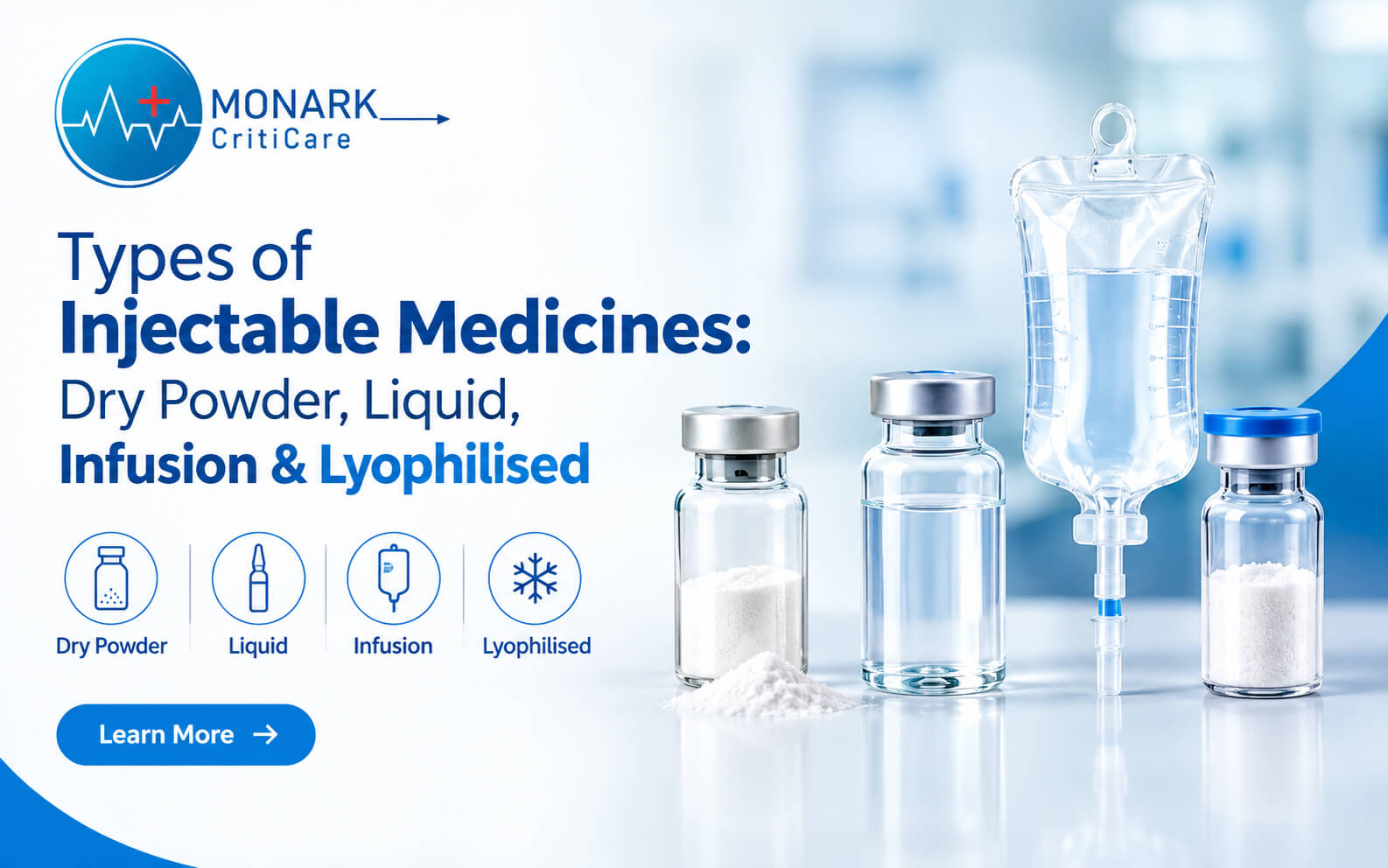
Hospitals may also procure intravenous infusion products and other sterile injectable formulations based on their clinical requirements.
A comprehensive hospital injectable product list should clearly distinguish between product names, strengths, dosage forms, and packaging configurations. This reduces confusion during purchasing and helps staff verify delivered products against purchase orders.
For more information about relevant product categories, explore Monark Criticare's critical care product list and critical care injection list.
Overview of Product Categories
|
Product category |
Key procurement considerations |
|---|---|
|
Injectable anti-infectives |
Active ingredient, strength, approved indications, and documentation |
|
Cephalosporin injections |
Specific molecule, formulation, packaging, and product approvals |
|
Emergency medicines |
Approved specifications and storage requirements |
|
Cardiovascular medicines |
Formulation, handling, and institutional requirements |
|
IV infusions and other injectables |
Packaging, product specifications, storage, and transport |
This table provides a general procurement framework. Buyers should confirm the actual products available in the supplier's current catalogue before placing an order.
3. How to Choose a Critical Care Medicines Supplier
Choosing a suitable critical care medicines supplier requires more than comparing prices. Hospitals, distributors, and institutional purchasing teams should evaluate the supplier's product portfolio, regulatory documentation, communication practices, and ability to meet agreed supply requirements.
Review the Pharmaceutical Product Catalogue
A clearly organised pharmaceutical product catalogue helps buyers identify relevant products and prepare detailed enquiries. Product information should specify the medicine name, strength, dosage form, packaging, and other relevant details.
Before confirming an order, ask the supplier to verify current availability, minimum order quantities, lead times, and applicable commercial terms.
Monark Criticare's critical care product range is a useful starting point for exploring its published product categories.
Verify Quality and Regulatory Documentation
Quality assurance is an important consideration when procuring pharmaceutical products, particularly sterile injectable medicines. Depending on the product and transaction, buyers may need to verify relevant licences, product approvals, batch details, certificates of analysis where applicable, and other quality records.
Applicable Good Manufacturing Practice requirements and other regulatory obligations should be verified through appropriate documentation. Buyers should not rely solely on general marketing statements when assessing compliance.
Upon receiving a shipment, the hospital should check the delivered products against the purchase order and verify the applicable documentation, packaging, batch information, and expiry details.
Assess Supply Arrangements and Communication
A suitable pharmaceutical supply arrangement requires clear communication between the buyer and supplier. Hospitals should understand how orders are placed, how product availability is confirmed, and how delivery schedules are managed.
Before selecting a supplier, consider the following questions:
- Does the supplier offer the required product categories and formulations?
- Can the supplier provide relevant product and quality documentation?
- What are the minimum order quantities and expected lead times?
- Are storage and transportation requirements clearly communicated?
- How are delivery discrepancies and product complaints handled?
- Are pricing and payment conditions clearly documented?
Evaluating these factors can help institutional buyers determine whether a supplier's arrangements align with their procurement requirements.
4. Institutional Medicine Supply, Bulk Orders and Business Opportunities
Institutional medicine supply involves coordinating pharmaceutical purchasing for hospitals, healthcare facilities, and other eligible institutions. It may include formal procurement procedures, demand forecasting, supplier evaluation, and ongoing inventory management.
A structured purchasing process helps organisations compare offers, maintain records, and manage pharmaceutical requirements more efficiently.
Government Hospital Pharmaceutical Supply
Government hospital pharmaceutical supply may involve tenders, approved vendor lists, technical specifications, eligibility conditions, and defined delivery requirements.
The requirements vary between procurement authorities and individual tenders. Suppliers should carefully review the relevant tender documents before submitting an offer, while purchasing authorities evaluate bids against the applicable criteria.
Requirements may cover product specifications, licences, approvals, packaging, quality documentation, delivery schedules, and commercial terms. Companies should not assume that their general pharmaceutical portfolio automatically qualifies them for a particular tender.
For buyers, documenting technical requirements and comparing offers against the published specifications supports a more organised procurement process.
Bulk Medicines for Hospitals
Purchasing bulk medicines for hospitals requires balancing demand, budget, storage capacity, and product shelf life. Larger orders are not automatically more efficient if the products cannot be used before expiry or if storage capacity is insufficient.
Before placing a bulk order, procurement teams should consider:
- Historical consumption and expected demand.
- Existing stock and established reorder levels.
- Product shelf life and expiry management.
- Storage capacity and handling requirements.
- Delivery schedules and minimum order quantities.
- Budget limits and institutional purchasing policies.
These considerations are particularly relevant when managing inventory across several hospital departments or facilities.
Third-Party Pharmaceutical Manufacturing
Third-party pharmaceutical manufacturing is an arrangement in which a pharmaceutical product is manufactured under contract for another business, subject to applicable regulatory requirements and the terms of the agreement.
Businesses considering this model should assess product feasibility, manufacturing authorisations, quality systems, packaging requirements, contractual responsibilities, and market-specific documentation.
Third-party manufacturing is distinct from direct hospital procurement. Prospective clients should confirm whether the company offers the required service and clarify the applicable conditions before entering an agreement.
PCD Pharma Franchise Opportunities
A PCD pharma franchise generally involves an arrangement for marketing and distributing pharmaceutical products under agreed commercial terms. Depending on the agreement, this may include territory-related conditions, product availability, promotional support, and distribution responsibilities.
Prospective partners should review the agreement, verify applicable licences, and understand their regulatory obligations before starting operations.
For further information about relevant product categories, visit Monark Criticare's critical care product list for pharma franchise businesses in India.
Pharmaceutical Export Considerations
Pharmaceutical export involves additional requirements beyond domestic procurement. Depending on the product and destination market, these may include product registration, import permissions, labelling requirements, quality documentation, and other regulatory obligations.
Exporters should verify the applicable requirements for each product and destination before confirming a transaction. Initial enquiries should clearly identify the target country, product specifications, requested quantities, and required documentation.
5. Exploring Monark Criticare's Critical Care Product Range
Hospitals, pharmaceutical distributors, and institutional buyers need accurate product information before deciding whether a supplier meets their requirements.
Monark Criticare's published critical care product catalogue provides a starting point for exploring its critical care product range.
Prospective buyers should confirm current product availability, specifications, applicable regulatory status, documentation, order quantities, and commercial conditions directly with the company.
Contact Monark Criticare
Manufacturing and office:
Plot No. 201, Ground Floor, HSIIDC Phase 1, Industrial Area Alipur, Barwala, Panchkula, Haryana 134118, India.
Email: monarkcriticare@gmail.com
Phone: +91 90567 60548 | +91 98886 56719 | +91 93176 92852
WhatsApp: +91 90567 60548
Contact the team to enquire about product specifications, institutional supply requirements, and applicable commercial arrangements.
Conclusion
Effective pharmaceutical procurement starts with clear requirements, accurate product information, and a structured supplier evaluation process. For hospitals and institutional buyers, reviewing product specifications, quality documentation, inventory requirements, and supply arrangements can help make purchasing decisions more informed.
Whether you are researching critical care injectable medicines, anti-infective injectable products, or options for institutional pharmaceutical sourcing, begin by defining your requirements and verifying the available product range.
Official Government Sources for Pharmaceutical Quality and Supply
When selecting critical care pharmaceutical products for hospitals and institutional supply, buyers should consider applicable drug regulations, manufacturing quality standards, and pharmaceutical distribution practices. The Central Drugs Standard Control Organization (CDSCO), under India’s Ministry of Health and Family Welfare, provides official information on drug regulation, licensing, and quality requirements. Its guidance and the Drugs Rules, 1945, including revised Schedule M Good Manufacturing Practices (GMP) requirements, are useful references when evaluating pharmaceutical manufacturers and suppliers.
For institutional procurement, hospitals and healthcare organizations should verify the relevant product approvals, manufacturing or marketing authorizations, storage requirements, batch documentation, and supplier credentials as applicable. These checks can help support responsible purchasing and maintain product quality throughout the supply chain.
Official resources:
Use these government resources to support regulatory and quality-related statements. Confirm any specific compliance claims about a supplier or product against current documentation rather than assuming compliance.
Frequently Asked Questions
1. What are critical care pharmaceutical products?
These are medicines used in hospital settings to support the management of serious illnesses and urgent clinical conditions. Categories may include injectable anti-infectives, emergency medicines, cardiovascular products, and other formulations selected according to clinical requirements.
2. What should hospitals consider when choosing a critical care medicines supplier?
Hospitals should evaluate product suitability, applicable licences, quality documentation, batch traceability, product availability, storage requirements, delivery arrangements, and commercial terms.
3. What are anti-infective injectable products?
These are medicines administered by injection for appropriate infections or other approved indications. Their selection depends on the active ingredient, clinical circumstances, approved product information, and professional prescribing guidance.
4. How can hospitals prepare a critical care product list?
Hospitals can develop a list based on their approved formulary, departmental requirements, product specifications, inventory records, and procurement policies. The list should be reviewed periodically as requirements change.
5. What is involved in government hospital pharmaceutical supply?
It may involve tender participation, vendor eligibility requirements, technical specifications, product approvals, quality documentation, and defined delivery and commercial conditions. Requirements depend on the relevant procurement authority.
6. What is the difference between third-party manufacturing and a PCD pharma franchise?
Third-party manufacturing concerns contracted production of pharmaceutical products, while a PCD pharma franchise generally concerns marketing and distribution under agreed commercial terms. Responsibilities depend on the agreement and applicable regulations.
7. How can buyers request a pharmaceutical product catalogue?
Buyers can contact the pharmaceutical company through its official enquiry channels to request product information, specifications, current availability, and commercial details.
Disclaimer: The information provided in this article is for general informational purposes only and does not constitute medical advice. Pharmaceutical product details and availability may change. Medicines and injectable products should be used only under qualified healthcare supervision and in compliance with applicable regulations. Hospitals and institutional buyers should verify product specifications, approvals, availability, and supply terms directly with Monark Criticare before placing orders. Monark Criticare is not responsible for decisions made solely based on this content.